'Wanderer in the mists' (1818) Caspar David Friedrich


1. What and when was the Enlightenment?
The Elightenment was an era in Western philosophy during the 17th and 18th century where there was a
2. Define the concept of the Sublime.
Sublime is defined as "the quality of greatness or vast magnitude, whether physical, moral, intellectual, metaphysical, aesthetic, spiritual or artistic" So something which is of great power which you are able to see in landscape paintings.
3. How did the concept of the Sublime come out of the Enlightenment thought?
Before the Enlightenment era, landscape paintings were not important and were only seen in the background, unlike religious paintings which were the main focus of artwork at that time. However during the Enlightenment, artists wanted to show off the beauty of the nature and it wasn't until the beginning of this era that more landscape painting were being produced to create sublime setting artwork.
4. Discuss the subject matter, and aesthetic (look) of Misrach's work to identify the Sublime in his work. Add some more images of his work.
Richard Misrach likes to capture the relationship between man and the landscape in his artwork. In "Untitiled #2" (2002) he uses a birds-eye type viewpoint to capture the vastness and the Sublime element in his work. As you can see there is a lone person standing by the waters edge on the beach. This gives a feeling of isolation and vulnerability for the man standing alone against the power of nature, because even though the water looks beautiful in all its glory there is also a hidden threatening element to it. The huge and rippling ocean in "Untitled #394-03" (2003) shows two people swimming, which again shows the insignificance of humans against its magnificent beauty.

"Waiting, Edward's Air Force Base, California" (1983)

"The Santa Fe"(1982)
5. Identify some other artists or designers that work with ideas around the Sublime, from the Enlightenment era as well as contemporary artists.
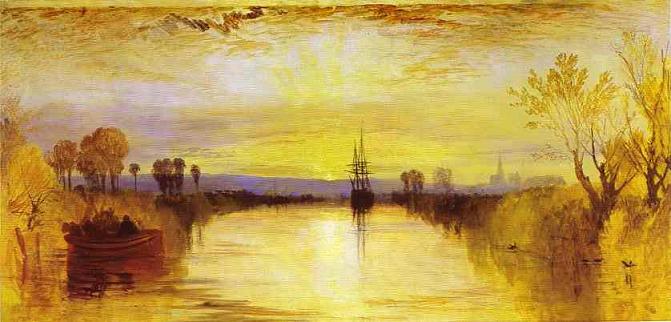
J.W.T "Chichester Canal" (1828)
Joseph William Turner was an English Romantic landscape painter, watercolourist and printmaker during the Elightenment Era. He is regarded as one of the artist who elevated landscape paintings during a time when religious and historical paintings were the only paintings of importance. Due to his style he is also known as "the painter of light" and his work regarded as a "Romantic preface to Impressionism."

Mariele Neudecker "Unrecallable Now" (1998-2001)
Mariele Neudecker is a German Artist who works with landscape sculptures and video installations which are used to submerge her viewers inside the sublime. Her work is "attempting to challenge conventional ways of seeing and re-considers the dichotomy between nature and culture"
6. How does Misrach's photography make you feel? Does it appeal to your imagination?
I see the beauty and power of nature in Misrarch's photography and it gives me a sense of awe and respect for the world around me. This appeals to me as it shows me that a great piece if artwork can be made just by catching the elements of nature and the details within it. His work shows me how to work with space and surrounding area around us.

Building from "Half Life 2"
http://europeanhistory.about.com/od/thenineteenthcentury/a/enlightenment.htm
http://wiki.answers.com/Q/What_was_The_Enlightenment
http://en.wikipedia.org/wiki/Sublime_(philosophy)
http://www.vam.ac.uk/collections/paintings/galleries/further/essay/romance/index.html
http://www.vincentborrelli.com/cgi-bin/vbb/105104
http://www.artnet.com/usernet/awc/awc_workdetail.asp?aid=424216474&gid=424216474&cid=157764&wid=424331219&page=1
http://www.formatnetwork.com/mariele/neudecker.htm
http://www.fastcodesign.com/1662156/glitches-turn-video-games-into-sublime-art

I be-leave that ur sumorie of the enlightenment is a little wrong. the enlighten ment or the age of reason was morely based upon the 18th centre. rather then between the 17th and 18th centre as u had said. . do you think that if ther wasnt and age of reason or enlightenment, that ther wouldn't then be an age of sublim. without these ages in history, to ur resurch this would mean that that people would not be painting landscape today. do u think this would be the case if these two major ages in history did not happen?
ReplyDeletecheers :)
I agree that you can also see the power of nature in Misrach's photography because his images show vast landscapes so you can have the feel of the big world compared to you as a tiny, miniscule part of the world. The power of nature that he shows in his photographs is the fact that it is so big and can do so many glorious things that bring 'awe' , happiness and horror to u.
ReplyDeleteI think that you have summed up some of the main key points of misrach's work nicely such as when you said there is a 'hidden threatening element to it.' a lot of people have made the mistake in viewing his work that it is just about beauty and i think you have got it right the people are so small because being in something you cant control such as the ocean is a big threat. Waves can kill you and drown you, you cant control what happens in nature. Also the pictures of people in the ocean especially just one person does give the viewer a sense of insolation because you are alone in a big wide scape that goes on and on almost for forever.
Wow, Misrach’s photographs are beautiful. I love your discription of the solo man standing against nature. His use of space is so good. He manages to keep it so empty all while being completely balanced. Although I do not understand how this appreciation of nature and landscape came out of a recjection of religion. The shift toward logic—the age of reason—seem to oppose the sublime in my mind. Why would anyone decide logically to sit and stare at nature, that seems illogical, not that I’m against it, it’s good fun. I just don’t understand the connection between the sublime and the enlightenment. Seems more like it was just something that happened after not because of.
ReplyDelete